How to make sense of ISO tax treatment (+ examples)

22 min
0 result
John’s a Director at Secfi, helping founders, executives and employees navigate equity compensation and access to liquidity through his expertise in finance.
If you work for a tech startup or pre-IPO company, you may have been granted incentive stock options (ISOs). Hopefully, they'll make you money someday. But how much you make will depend on how they're taxed.
The trouble is it isn't easy to find clear and reliable information on how ISO taxation works. Most info you'll find online isn't specific to the tech startup situation. Or it's written in jargonese, or it's too high-level to be practically useful.
That's why we've put together this guide to ISO tax treatment — written in plain English. Here, we cover:
Note. ISO taxation is a rabbit hole of complexity. While we've tried our best to provide a clear overview, how much tax you actually owe will depend on your specific circumstances.
That's why, if you want a reliable breakdown for your personal situation, you'll need something better than a general guide. Our AI equity assistant, Maeve, can help give you clarity on your potential tax liability and help you work out the best equity strategy for your position. It's free to use. As always, Mauve is for informational purposes only. Please always consult a tax professional regarding your particular situation.
Incentive stock options (ISOs) are a type of stock option that receives a more favorable tax treatment than other types of options, such as NSOs (non-qualified stock options).
If you're an employee, when an early-stage tech startup gives you equity compensation, it's usually in the form of ISOs. These are specifically meant as a form of employee compensation. On the other hand, startups can award NSOs more broadly — for instance, to external advisors.
Like NSOs, ISOs usually have what's called a "vesting schedule", essentially a timeline of when these options are granted to you. Before your ISOs "vest", you won't be able to access them. This is to stop you from receiving lots of ISOs and quitting your job immediately.
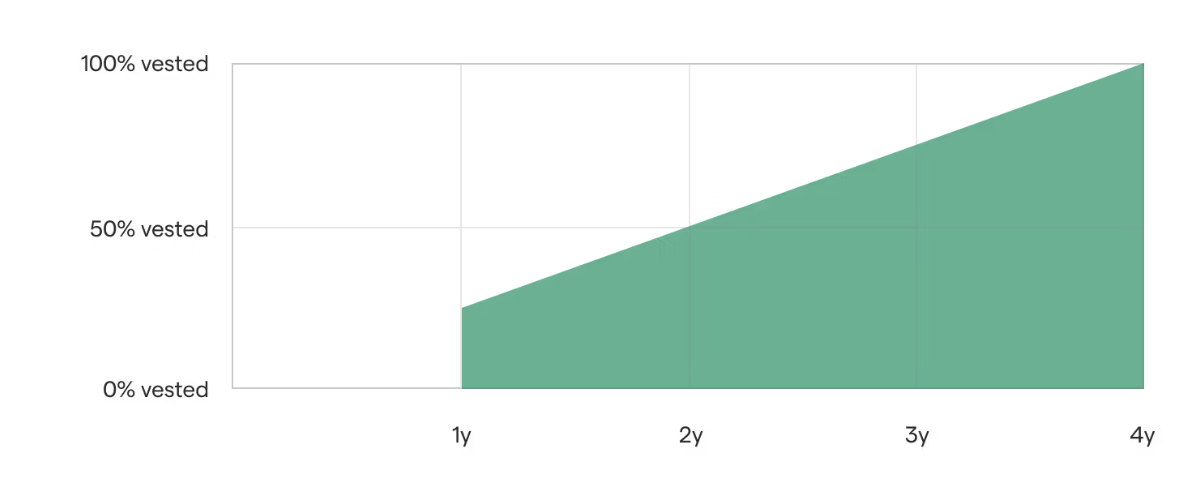
For illustrative purposes only. Actual results may vary, and there is no guarantee of any particular outcome.
With ISOs, you're less likely to be taxed when you exercise them — and if you are taxed, it's at a lower rate than with NSOs. Then, when you make a profit on shares at sale, you're taxed again at an effective rate that's lower than with NSOs.
One thing to be aware of, though, is that how much tax you'll pay depends on how long you hold the shares for after you exercise them. To "qualify" for the lower tax liability, you need to hold your shares for over 12 months after you exercise them. That's why, generally speaking, it's best to exercise early.
So, if you've been given ISOs as part of a compensation package, you'll have the opportunity to take advantage of some considerable tax benefits. However, as you can see already, there are some complexities to be aware of.
ISOs are often touted as being tax-free. While they are tax-free in principle, the reality is a little more complicated than that.
That's because of the alternative minimum tax (AMT), a tax system that works in parallel with the regular income tax system. Technically, AMT is just an "exception" that kicks in if you exercise a lot of ISOs and go above your yearly AMT threshold. However, in practice, many employees reach that threshold pretty quickly.
So, in reality, many employees pay tax twice on ISOs:
However, you have to pay tax at these two events, because you'll need to pay in advance at exercise. The amount of tax you pay at exercise may get subtracted from what you pay when you sell your shares at a gain.
Let's take these two moments of taxation in detail.
In short:
Let's go through this step-by-step.
When you exercise an ISO, you pay its strike price to your company to buy a share. Say you have ISOs with a $3 strike price.
The difference between the strike price and the current 409A valuation is considered a phantom gain (or "assumed gain" or "spread") by the IRS. This is because you're in effect making a gain by purchasing a share below its current value — even though you're not actually making any money.
So, say the current 409A valuation is $35 a share. If you pay $3 (your strike price), then you're making a $32 phantom gain in the eyes of the IRS. This gain gets taxed under the AMT system.
(That's why it makes sense to exercise as early as possible. Imagine that the 409A valuation becomes $50 a share. You're assumed gain becomes $47 — meaning you'll owe more in AMT.)
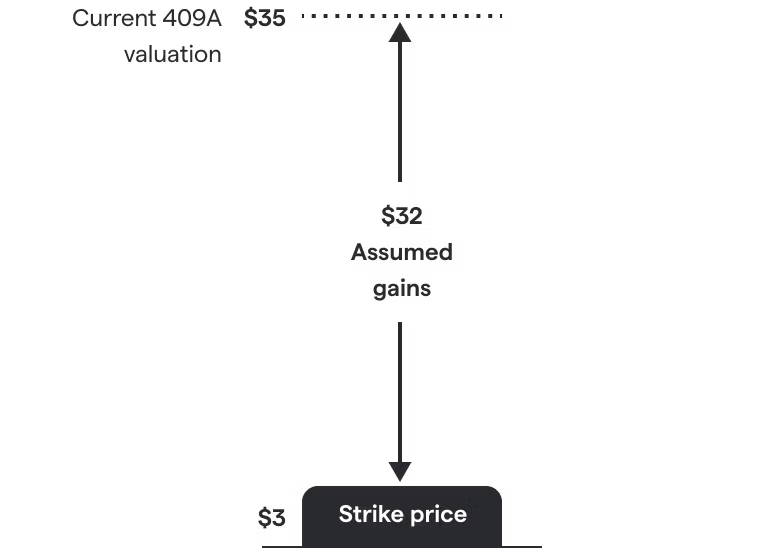
For illustrative purposes only. Actual results may vary, and there is no guarantee of any particular outcome.
The AMT is a tax you normally don't encounter, but it kicks in when you're exercising your ISOs.
Generally, AMT is designed to ensure that higher-income taxpayers pay a fair minimum amount of federal income tax. It reduces or eliminates certain tax deductions, exclusions, and tax breaks, preventing taxpayers from using too many tax advantages to significantly lower their tax bill.
Under the AMT system, you calculate your tax liability twice: once using the ordinary income tax rate and once using the AMT rules. You then pay whichever amount is higher.
When it comes to ISOs, AMT applies to the spread between your strike price and your 409A valuation. Even though you haven't actually made any money, you'll still need to pay this tax. This can feel a little unfair, as you're being taxed just on a paper gain.
How much you owe, though, can get a little complicated and it heavily depends on your personal situation, including factors such as:
As an example, in California the AMT is usually around 35% on combined Federal and State AMT. If we assume you bought shares for $3 and the current 409A valuation is $35, you have a phantom gain of $32. A 35% rate means that each ISO you exercise builds up $11.20 of AMT (this is a simplified example and the actual calculation is a lot more complex).
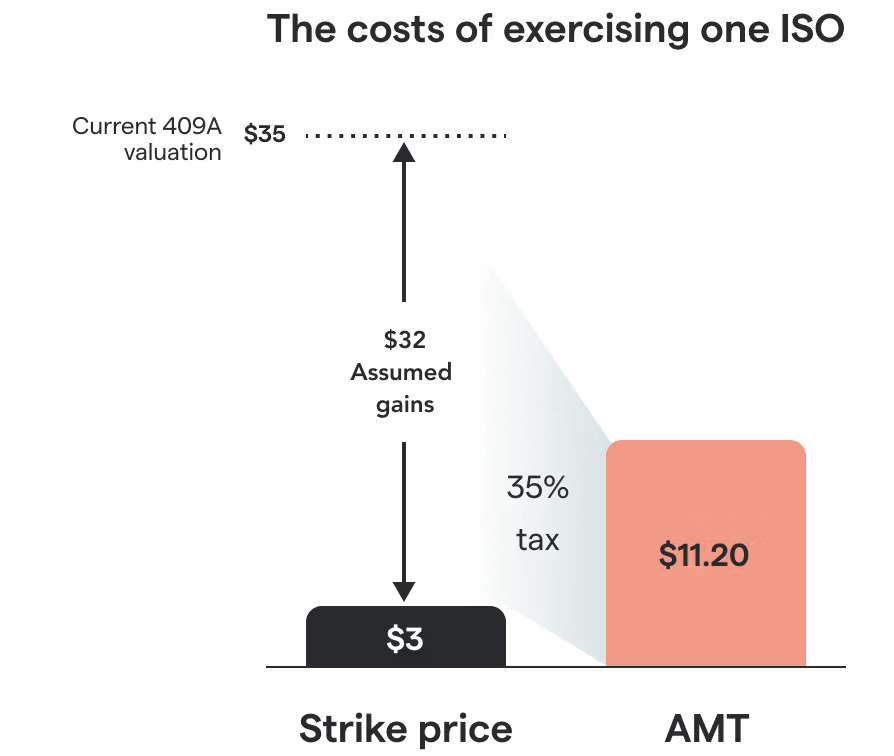
For illustrative purposes only. Actual results may vary, and there is no guarantee of any particular outcome.
The thing is that everyone has a unique AMT threshold beneath which they don't have to pay any AMT. This threshold depends on your personal circumstances. It's only if you exercise enough ISOs and cross that threshold that the tax applies.
That's why it's really best to talk to an equity specialist or strategist — or use our AI equity assistant, Maeve — to help you calculate your specific liability. As always, please consult a tax professional regarding your particular circumstance.
When you make money by selling your equity in an IPO or acquisition, your gain — i.e. the sell price minus the strike price — is taxed.
With ISOs, your gain gets taxed either as:
Which one you get taxed by depends on how long you've held your shares. By default, you pay the ordinary tax rates — that's the highest possible rate and the same as your salary.
However, you can pay long-term capital gains instead if you sell your shares at least 12 months after exercise (and 24 months after grant date). In this case, your shares count as a "qualifying disposition", allowing you to access the lower long-term capital gains rate.
That said, exercising your options before an IPO is costly and risky. You need to pay tax upfront, and there's no guarantee that you're going to exit. However, if you do exit, the tax savings can be worth it.
Note. If you exercised and already paid AMT on your phantom gain, you're not just eating that cost. It gets subtracted from what you owe on your sale, and if you paid more in AMT than your regular tax at the time, the difference becomes something called an AMT credit (or minimum tax credit) that you can use in a future year.
Typically, with stock options, you first exercise them to get a share and then you hope to later sell that share at a gain.
However, these two events can happen at the same time: you buy the share and immediately sell it, as if you had directly sold the ISO. You just have to wait until your company exits — otherwise its shares aren't sellable.
This is called a cashless exercise, since you don't have to come up with the cash to cover the upfront costs. It's a popular strategy because exercising prior to the exit can be expensive and risky. With a cashless exercise, you can immediately make money too, as the costs are withheld from your proceeds and you're guaranteed to have the cash to cover any taxes later on.
The trouble is, in terms of tax, a cashless exercise doesn't give you the long-term capital gains tax discount.
Instead, the two taxable events — exercising and selling — blend into one. In this case, you didn't exercise at least a year prior to selling, so you don't have a qualifying disposition. As such, your gains get taxed as ordinary income rather than as long-term capital gains.
So far, we've shared the basic details of how ISOs are taxed. However, you'll have noticed that how much you owe will change depending on the actions you take — including when you exercise, when you sell, and how much you earn from other income.
This means that there's an element of strategy to ISO taxation: to keep as much of your money as possible from your ISOs, you need to make the decisions that are right for you.
One of your most important considerations will regard the so-called qualifying disposition. Remember, you get a major tax discount if you sell your shares at least 12 months after you exercise them (and 24 months after they are granted to you), because these shares qualify for long-term capital gains tax.
To benefit, it makes sense to exercise your options as early as possible. However, there are two reasons why many employees are reluctant to do this:
If you can't afford to pay out of pocket, you may not be able to exercise — and you risk missing out on the overall tax discount. (By the way, your employer won't withhold the taxes you owe. It's up to you to pay them.)
As such, deciding when to exercise is expensive and risky, and it adds some complexity to your equity decision-making.
To illustrate how much you can earn and save by exercising and selling your shares at different times, let's consider an example in detail.
Say you join a startup and get 15,000 ISOs with a $3 exercise price. Eventually, the company IPOs and you get to sell the shares for $150 each.
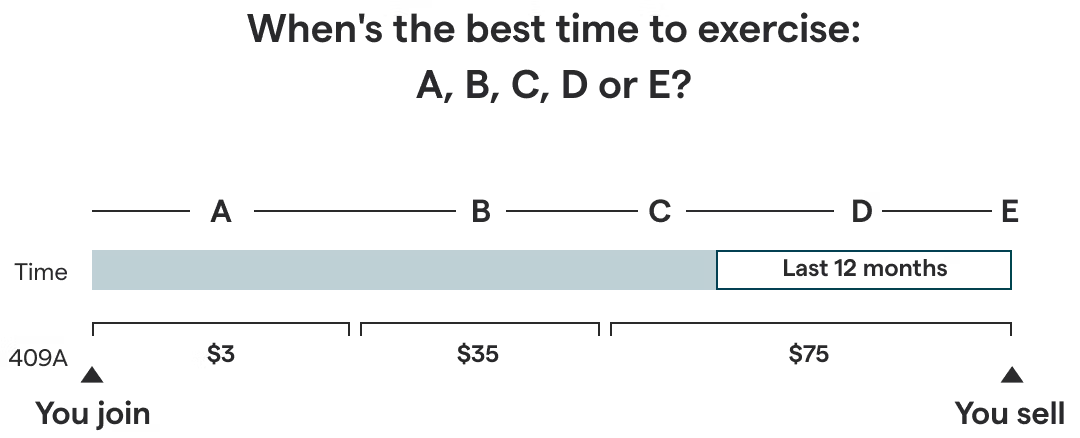
Over time, the 409A valuation of your company grows on this timeline:
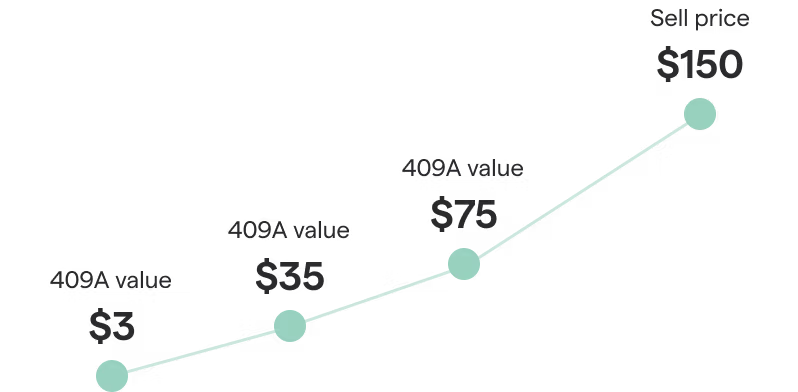
For illustrative purposes only. Actual results may vary, and there is no guarantee of any particular outcome.
Then this gives five distinct moments at which you could exercise:
For illustrative purposes only. Actual results may vary, and there is no guarantee of any particular outcome.
You could exercise at any of these points in time. But, as you've seen above, the tax implications would be different at each. Plus, the amount of cash you need to exercise will change too.
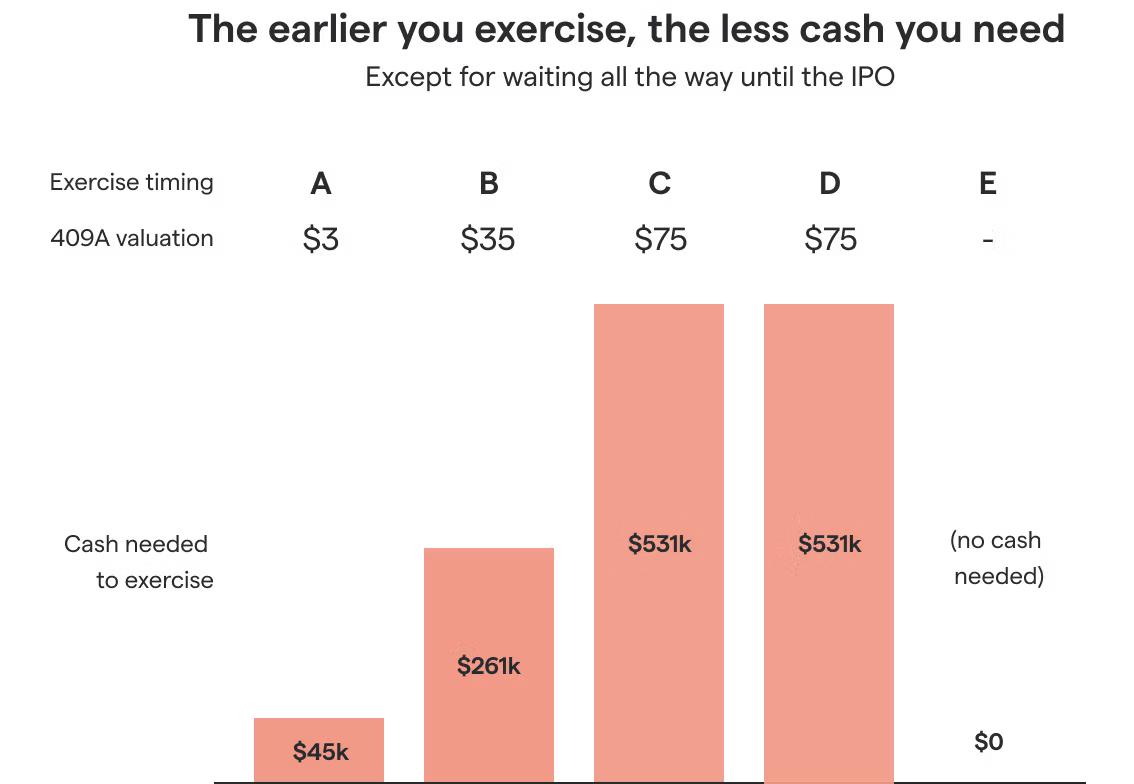
Here's the amount of cash you'd need to exercise at A, B, C, D or E (remember, these numbers include the AMT you will owe upfront):
For illustrative purposes only. Actual results may vary, and there is no guarantee of any particular outcome.
If you wait all the way until you sell (point E), you don't need any cash to exercise, because you can cover the costs with your proceeds.
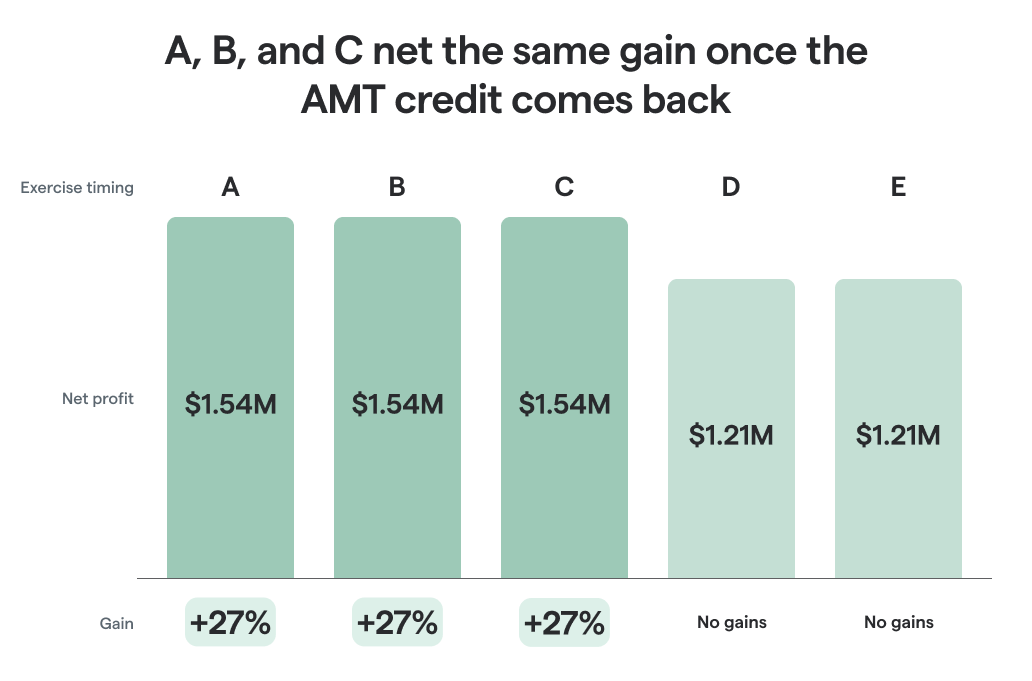
But if you exercise before selling, you need to pay out of pocket — and the higher the 409A, the more cash you need. If you do exercise before selling, though, you end up with a much higher net gain once the AMT credit comes back.
As you can see, if you exercise at least 12 months prior to selling — in this case at A, B and C — your net gain is higher:
For illustrative purposes only. Actual results may vary, and there is no guarantee of any particular outcome.
The sums that you can owe in order to exercise can be quite intimidating. $261,000 or even $531,000 is a huge amount to pay upfront for your ISOs.
Unfortunately, these are pretty common numbers for employees at the most successful and high-growth startups. And even if you have that kind of money, putting your personal savings on the line is risky since it's not guaranteed that your company will actually manage to reach a successful exit.
So what do you do if you still want that tax savings? Or what if you recently left your company and now have a deadline to exercise?
That's exactly why exercise financing exists. Think of it as a way to access support to pay for your exercise, so you don't have to cover the costs upfront. Here's how it works:
In the rest of this guide, we share what we do at Secfi to help you get clarity on your equity position and finance your exercise.
Understanding the general rules around ISO taxation is only one part of the picture. Getting to grips with how it impacts you — and then making the right decision — is the real challenge.
At Secfi, we can help you navigate that challenge. We were founded to help startup employees navigate their equity compensation, and today we provide tools, guidance, and financing to make this as easy as possible.
So, whether you're trying to calculate your tax bill, evaluate the best time to exercise, or find the capital needed to purchase shares, Secfi can help you make decisions with confidence.
Here are three ways that we can help you maximize the value of your ISOs while managing your tax obligations.
ISO taxation can be complex because your tax bill depends on a range of factors, including how many shares you have, the strike price vs 409A valuation vs the sale price, and the timing of your exercise and sale.
That's why general advice is only of limited value when you're looking to understand how much you might owe. You really need guidance, with information specific to your particular circumstances.
Our AI equity assistant, Maeve, offers exactly that. Maeve uses data you provide to help you understand the tax implications of different exercise strategies before you make a decision. To make that easy, you can directly with Carta and other cap table software so you seamlessly import the relevant details of your equity.
You'll be able to clearly see your phantom gain and any potential AMT impact, the cash required to exercise, and any potential proceeds under different exit outcomes. Plus, you can model scenarios such as:
Unlike other AI tools, Maeve uses data on your specific equity and your financial position, to give you reliable, tailored forecasts. It's an easy way to get answers to equity and tax questions in plain English, based on your actual financial situation. Again, it's very important you review this information with a tax professional.
Every employee's financial situation is different, and ISO decisions should be considered within the context of your broader financial goals.
That's why it can be useful to talk to an expert equity strategist, to help you figure out and evaluate what actions you can take to maximize the value you get from your ISOs.
At Secfi, our equity strategists can help you to make decisions on when to exercise and sell — and give you clarity on key considerations, such as how much you'll need to pay in AMT liability. They'll talk you through the potential tax consequences of different options and help you to maximize your wealth long-term.
Plus, they'll help you develop a personalized plan that aligns your equity decisions with your broader financial objectives, so you can take a wider view of your wealth strategy. For instance, together you can consider your net worth and how much of it is tied up in company stock.
As we shared above, many employees understand the value of their ISOs but lack the cash needed to exercise them. At exercise, you need to cover not just the strike price, but any AMT obligations and other taxes transaction expenses.
At Secfi, we offer non-recourse financing specifically for startup equity holders. If you're eligible, we can help you to:
As our financing is non-recourse, your personal assets are protected if your company doesn't achieve a successful exit.
It's one way to exercise your options early with less personal risk, so you can more easily access the upside of share ownership.
For many startup employees, there are two key challenges when it comes to ISO exercise:
Victor, an engineering leader at a pre-IPO startup, faced exactly these problems.
First, he'd tried to work out his tax liabilities himself. He built a number of charts that would model different scenarios and how much AMT he'd owe. But he really wanted to be sure he was getting it right.
Victor's bigger problem was that he'd saved money to cover the cost of exercise, but he hadn't considered the AMT costs. Having run his numbers, he felt he could cover the tax bill, but it wouldn't be comfortable.
That's why Victor ultimately turned to Secfi.
Secfi helped him understand the potential tax implications of exercising, including how AMT could affect his situation, and provided financing to cover both the exercise cost and potential tax liability.
And because the financing was non-recourse, he could participate in his company's upside without risking his personal savings. He also highlighted the clarity and guidance he received throughout the process, helping him make a decision that fit his financial goals and risk tolerance.
Read the full case study here: Why this engineering leader chose Secfi to finance his stock options
Testimonials are specific to an individual Client's experience and may not be representative of all Clients. Unless otherwise indicated, Clients offering a Testimonial do not receive compensation and their statement does not present a conflict of interest.
Getting the most out of your ISOs requires careful planning. The timing of exercise, the impact of AMT, and whether you qualify for long-term capital gains treatment can all have a significant effect on your eventual returns.
As such, there's no one-size-fits-all strategy. That's why it's important to understand not just the general rules around ISO taxation, but how they apply to your specific circumstances.
Whether you're evaluating when to exercise, estimating your potential tax bill, or looking for a way to fund your exercise without tying up personal savings, Secfi can help.
We offer personalized guidance, scenario modeling, and non-recourse financing — to help you make informed equity decisions and maximize the value of their ownership.
Try our AI equity assistant, Maeve, for free, to start planning your equity strategy.
The tax impact of exercising ISOs depends on factors such as your strike price, your company's current 409A valuation, your income, your filing status, and where you live. In particular, you may owe AMT on the spread between your strike price and the fair market value of the shares.
Because every situation is different, it's often helpful to model multiple exercise scenarios before making a decision. Tools like Maeve, our AI equity assistant, can help you estimate potential tax liabilities and compare different exercise strategies.
Not necessarily. Exercising early can help reduce AMT exposure and start the clock on your holding period requirement, potentially lowering your future tax bill through long-term capital gains. However, exercising also requires cash upfront and involves risk, since there's no guarantee your company will have a successful exit.
The best approach depends on your financial situation, your confidence in the company, and your long-term goals.
Many startup employees find that the cost of exercising options and paying potential taxes is prohibitively expensive. In these situations, some choose to wait until a liquidity event, while others explore exercise financing.
Providers such as Secfi offer non-recourse financing that can cover exercise costs and taxes, allowing employees to exercise without putting their personal savings or assets at risk.
The tool shown here uses artificial intelligence and is for illustrative purposes only and not necessarily indicative of future results and there is no guarantee that similar results can be achieved. The information provided by the tool is not professional advice and is not intended by Secfi, Inc., its affiliates, and Secfi representatives, to be deemed as investment, legal, tax or other professional advice or recommendations of any kind, or to form the basis of any decision to do or to refrain from doing anything. Secfi does not review the accuracy or completeness of the information provided to us within the tool.